Aztec (Mexica)
Central Mexico, c. 1300-1521 CE.
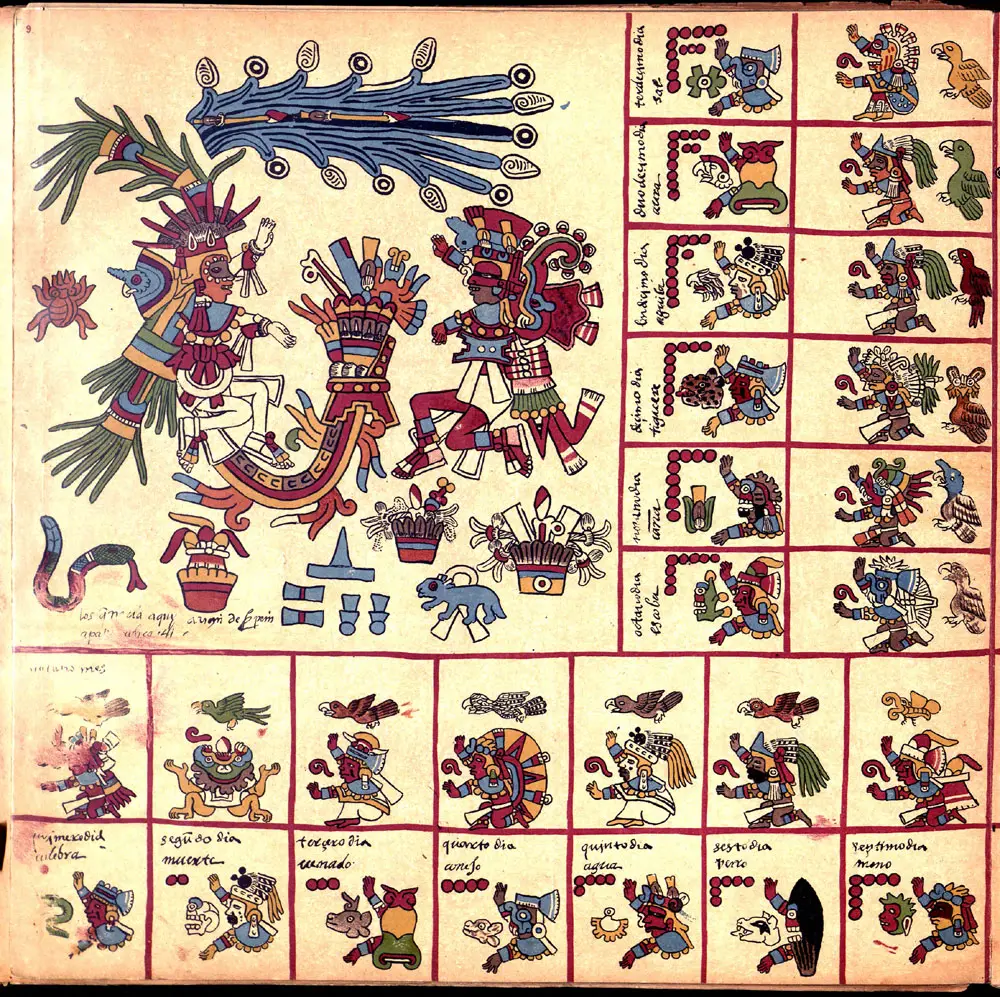
Most of what we know comes through Spanish friars, above all Bernardino de Sahagún's Florentine Codex, compiled with Nahua elders and scribes from the 1540s on. Pre-conquest painted books survive in tiny numbers. Names and roles vary between city-states, and the friars' filter is a real limit.
Family graph
Parent lines run downward, partners are joined by a thicker line. Select a deity to trace its ancestry.
The deities
Ometeotlduality, the creative pairTezcatlipocanight, fate, sorceryQuetzalcoatlwind, learning, priesthoodHuitzilopochtlisun, war, Tenochtitlan's patronCoatlicueearth, mother of HuitzilopochtliCoyolxauhquithe moon (by interpretation)Tlalocrain, mountains, fertilityChalchiuhtlicuerivers, lakes, childbirthTonatiuhthe fifth sunMictlantecuhtlithe dead, Mictlan, the underworldMictecacihuatlthe deadXipe Totecspring renewal, goldsmithsXochiquetzalflowers, love, craft
Today
Nahuatl-speaking people, more than a million, live in Mexico today. Most are Catholic; some communities keep forms of the older practices and some revivalists work to reconstruct them. The Mexica state religion ended with the Spanish conquest of 1521.
More traditions
Sources used
- Bernardino de Sahagún, Florentine Codex (Historia general de las cosas de Nueva España, c. 1545-1590)
- Codex Borbonicus (c. 1520s)
- Histoyre du Mechique (c. 1543)
- Leyenda de los Soles (Legend of the Suns, 1558)